The Word That Stayed Outside
A reflection on Universal Oneness at Madison Square Garden
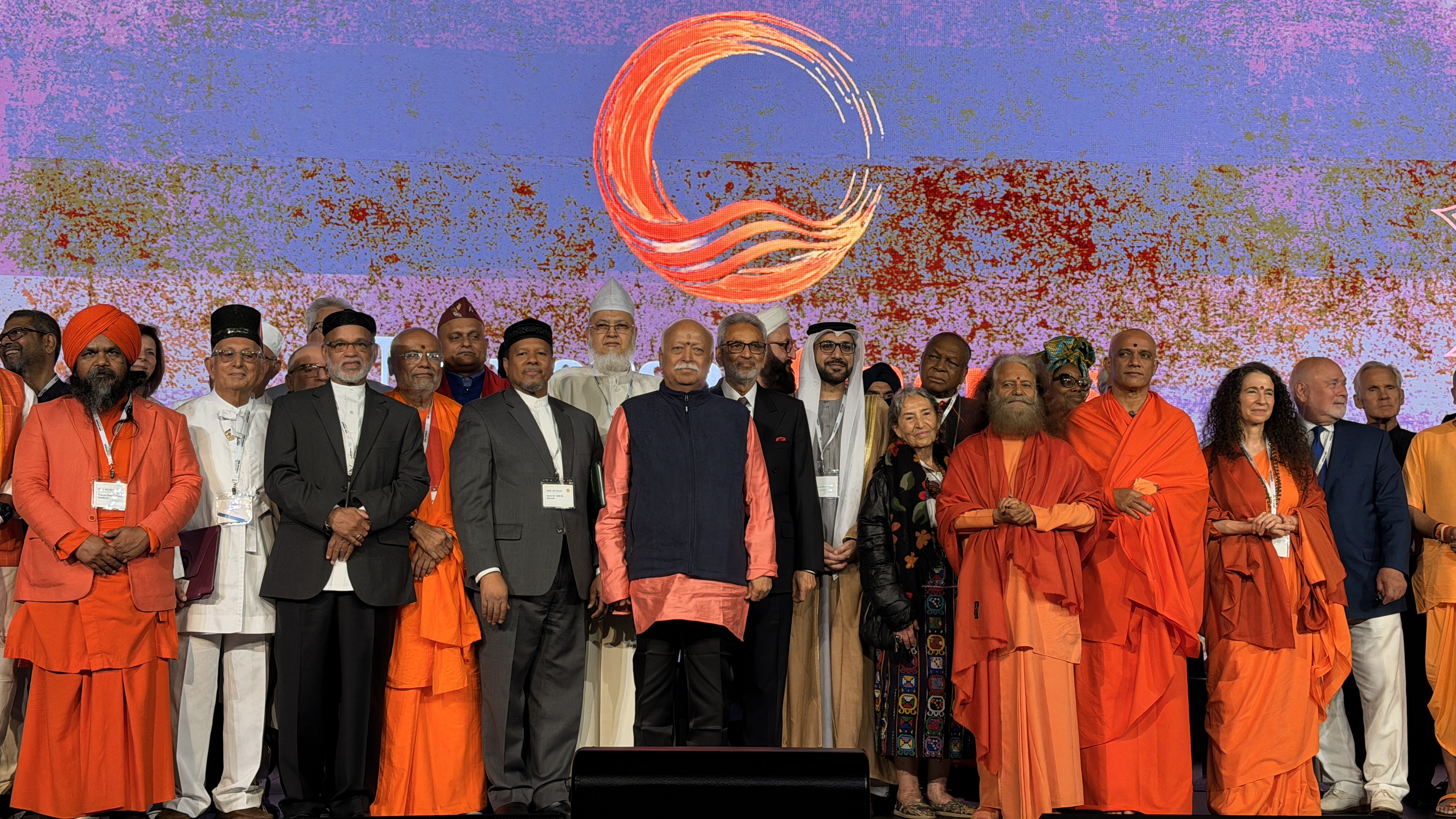
This past Saturday I went to Madison Square Garden for what I understood to be one of the largest Hindu gatherings in America.
More than 5,000 people came, from 39 states and over 850 cities. More than 180 interfaith leaders from 30 countries were there, along with representatives of some 250 supporting organizations. It fell on Raksha Bandhan, and the theme — Universal Oneness — could hardly have been more fitting.
Outside the Garden, a few hundred protesters had gathered in opposition to the RSS and its leader, Dr. Mohan Bhagwat. Their signs were direct, their criticism unmistakable. And displayed prominently on many of their placards was a single word: Hindu.
Inside, over roughly two and a half hours, something struck me. I don't recall hearing that word even once. Maybe I missed an occurrence, but the broader absence was hard to miss. We heard about Bharat. We heard about civilization, diversity, humanity, harmony, oneness — all worthy ideas. The word Hindu seemed almost conspicuously absent, and not only from the speeches. It wasn't on the flyers, the brochures, or the stage.
Here's what makes that strange. The tradition itself was everywhere.
Dancers moved through forms from Africa, Europe, Asia, the United States, and Bharat — the universal embrace, made visible and made beautiful. The program closed with Sanskrit recitation. And we turned to the strangers seated beside us and tied rakhis onto one another's wrists. On a Hindu festival, we performed the Hindu festival — in its oldest language, through its defining rite, with our own hands.
So the word wasn't missing for lack of the thing it names. The thing was right there in the room. Only the word stayed outside, on the placards.
That contrast has stayed with me.
Universalism shouldn't require anonymity
This isn't an argument for turning an interfaith gathering into religious triumphalism. Just the opposite. Interfaith engagement works best when people come to one another rooted in who they are.
A rabbi can say Shalom without diminishing the Christian, Muslim, Sikh, or Buddhist beside him. An imam can speak of Allah without abandoning the language of shared humanity. A Sikh can invoke the Guru; a Christian minister can speak of Christ. Their particularity doesn't weaken the fellowship. It's what gives the fellowship its authenticity.
So why should a Hindu feel that universal oneness requires the word Hindu to disappear?
The event fell on Raksha Bandhan. It would have cost the universal message nothing for one speaker simply to say, "Today, as we celebrate the Hindu festival of Raksha Bandhan…" That single sentence would have located the whole gathering honestly within the tradition from which the invitation to oneness was being extended. There's no contradiction between saying Hindu and saying humanity. There shouldn't be.
What we don't say also communicates
We tend to read public messaging through the words that are spoken. But sometimes the words that aren't spoken communicate just as much.
I'm not looking for hidden meanings or building a conspiracy out of one missing word. I sincerely hope the absence wasn't deliberate. But messaging isn't only about intention — it's also about perception. And when a gathering this visibly tied to Hindu society, held on a Hindu festival and attended overwhelmingly by the Hindu diaspora, appears reluctant to name Hindu identity, people will reasonably wonder why.
Was it an oversight? An attempt to seem more accessible? Concern about the political baggage some audiences attach to the word? A deliberate communications strategy? Maybe there are good explanations. But the question deserves to be asked, because strategy and self-confidence aren't the same thing. Good strategy may ask us to choose our words with care. It shouldn't ask us to be embarrassed by the vocabulary of our own identity.
Who was missing from the stage
There was another absence worth sitting with.
For nearly eight years, many of us have worked through initiatives like SewaDiwali to build relationships across Hindu, Jain, Buddhist, Sikh, and other Dharmic organizations. Those relationships weren't built overnight. They came through service, shared projects, and patient trust. Yet at an event built around Universal Oneness, I didn't see that broader Dharmic family meaningfully represented on the main stage.
That matters. Inclusion isn't communicated only by whom we say we value; it's communicated by whom people can actually see standing beside us. When an event speaks of universal belonging, the composition of the stage becomes part of the message. None of this erases the genuine achievement of bringing together leaders from so many traditions and countries — that's real, and worth honoring. But precisely because the aspiration was so large, we should be willing to look honestly at where the execution fell short.
A contrast worth considering
A similar gathering in Canada used the phrase Hindu Vishwa Bandhu — the Hindu vision of the world as one family. There's something quietly powerful in that formulation. The word Hindu doesn't compete with Vishwa Bandhu. It precedes it. The universal emerges from the rooted.
That order matters, because we often assume that becoming universal means diluting the particular. The tradition itself suggests the opposite. Its own vocabulary has long carried some of the most expansive ideas any civilization has produced — Vasudhaiva Kutumbakam, the world is one family, and Ekam Sat Vipra Bahudha Vadanti, truth is one, and the wise describe it in many ways. These are about as universal as ideas get. But they came from somewhere. There should be no embarrassment in saying where.
Confidence without defensiveness
The protesters outside shouldn't simply be waved away either. They came with serious objections to the RSS — its history, its ideology, its leadership. Whether you share those objections or reject them, their presence is now part of the reality in which such organizations operate in America. Inside and outside the Garden, two very different narratives were unfolding at once. That's what pluralism looks like: people celebrate, people criticize, people protest, and the public in between tries to work out what's actually being said.
Which is exactly why clarity of identity matters. When others are defining you loudly, ambiguity about how you define yourself rarely helps.
The point was never to shout the word Hindu louder than everyone else — that would miss it entirely. The point is whether we can say it naturally, without defensiveness, without aggression, without apology, simply as a statement of who we are. There's a difference between humility and hesitation. And there's a difference between thoughtful positioning and becoming so conscious of how others might see us that we start editing ourselves out of our own story.
That is the real question Saturday left me with: are we secure enough in our Hindu identity to speak from it openly while still embracing those who believe differently?
I believe we are.
The strongest universalism is not one in which everyone arrives stripped of identity. It is one in which a rabbi can say Shalom, an imam can invoke Allah, a Sikh can speak from the Guru Granth Sahib, a Christian can speak of Christ — and a Hindu can say, without anxiety or apology:
I come from this tradition, and from within it, I extend my hand to you.
That is not exclusion. It is not triumphalism.
It is confidence.
And perhaps genuine Universal Oneness begins there.
For Reflection
Where in your own life have you felt pressure to soften your identity in order to seem more welcoming — and what did that cost you?
Get notified of new essays
No spam. Unsubscribe any time.